Don’t just click “buy now.”

Buyer-Broker Agreements Aren’t the Trap. Bad Process Is.
A Washington real estate broker’s response to “Real Estate’s New Paper Trap”
Let me begin where I agree with James Rodriguez’s Business Insider article: springing a long-term, exclusive buyer-broker agreement on someone at the front door of a house is wrong.
A buyer should not be rushed into signing a contract while standing in an entryway, holding a child, excited to see a home, and worried that someone else may buy it first. A broker should explain the agreement before the showing, answer questions in plain language, and give the buyer enough time to make an informed decision.
If that did not happen in the case described in the article, the buyers had every reason to feel misled.
But the article’s opening is also clickbait. It takes an ugly example and frames the buyer-broker agreement itself as the trap. That paints a complicated process—and an entire industry—with too broad a brush.
The contract is not inherently the problem. The problem is accepting terms you do not understand, presented by a broker who has not earned your trust.
Why buyer-broker agreements exist
Buyer representation is real work.
A broker may spend evenings and weekends discussing neighborhoods, identifying properties, coordinating tours, evaluating comparable sales, reviewing seller disclosures, investigating issues, communicating with listing brokers, preparing offers, and guiding a buyer through negotiations—all without any guarantee that a transaction will close.
There have also been many instances in which a broker performed that work, showed buyers numerous properties, and then watched the buyers ask a friend, relative, or agent in another part of the state to write the offer.
A written agreement addresses that problem. It establishes who represents the buyer, what services will be provided, where and for how long the agreement applies, and how the broker will be compensated.
That is not unreasonable. Sellers have long signed listing agreements committing themselves to a brokerage, often with meaningful consequences for cancelling early or selling during a protection period. Buyer representation should not have to operate indefinitely on a handshake and a hope.
Legal forms are long and wordy because decades of disputes taught us that handshakes are not always enough. The answer is not to eliminate written agreements. It is to make the agreement—and the conversation surrounding it—clearer.
Everything important is negotiable
The settlement-driven MLS rules require participating brokers to enter into a written agreement with a buyer before touring a home. Those rules also require compensation to be stated clearly, prohibit open-ended compensation, and expressly disclose that commissions are not set by law and are fully negotiable.
Washington law separately requires a written services agreement before, or as soon as reasonably practical after, a broker begins providing brokerage services.
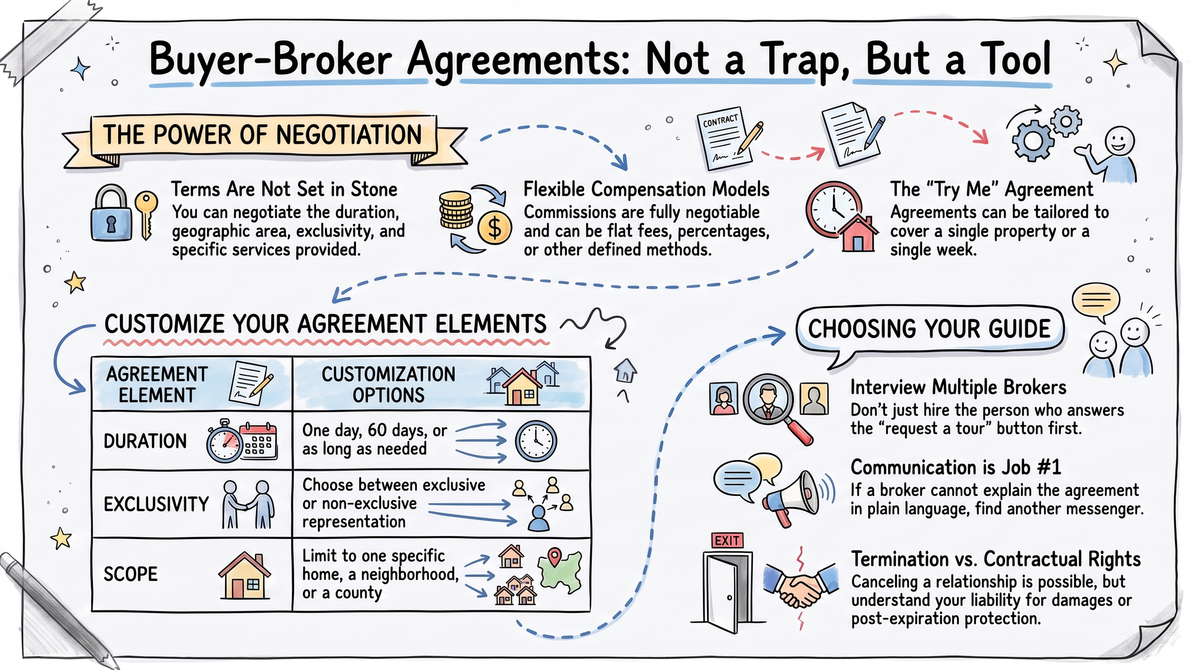
That agreement can be tailored.
The parties can negotiate:
- The duration of the relationship
- The geographic area or particular properties covered
- Whether the relationship is exclusive or nonexclusive
- The services the broker will provide
- The compensation, including a percentage, flat amount, another clearly defined method, or even zero
- How seller-paid compensation will affect the buyer’s obligation
- What happens if either party wants to end the relationship
- Any protection period following expiration
An agreement can cover one showing, one property, a neighborhood, a county, or a broader search area. It can last a day, a week, 60 days, or longer. It can be extended if the relationship is working.
The buyer is not required to accept the broker’s proposed terms. The broker is not required to accept the buyer’s terms, either.
That is what negotiation means.
I do not work under nonexclusive agreements. I also have a compensation threshold below which I will not accept an engagement. That is not because every buyer must agree with me. It is because I know the level of service I provide and what is necessary for me to provide it properly.
At the same time, I support “try me” agreements with shorter initial terms. I believe in my skills and services. If we work well together, extending the agreement is easy. If we do not, neither of us benefits from pretending otherwise.
Ending the relationship is not the same as erasing the contract
This is where precision matters.
Washington’s real estate brokerage pamphlet explains that an agency relationship may terminate when its term expires, by mutual agreement, or by notice from either party. But it also says that termination by notice does not eliminate either party’s contractual rights.
The standard Northwest Multiple Listing Service Form 41 makes a similar distinction. It does not contain a predetermined “early termination fee.” If a broker wants a specific cancellation fee, that term would need to be written into the agreement.
Form 41 does state, however, that a buyer who cancels an exclusive agreement without legal cause may be liable for damages the firm actually incurs. That is different from automatically owing a made-up fee, but it also means a buyer should not assume that cancelling makes every contractual obligation disappear.
The form’s post-expiration protection is narrower. Under an exclusive agreement, compensation after the term generally applies to a property that was brought to the buyer’s attention, found through the firm’s efforts or information, or specifically brought to the firm by the buyer during the term.
During the active term, the exclusive-agency provision can be broader. If the buyer purchases property within the defined area while the exclusive agreement is in effect, compensation may be due even if another broker writes the offer.
The lesson is not “you can never leave.” Nor is it “you can walk away without consequences whenever you want.”
The lesson is: read the term, the area, the exclusivity provision, the cancellation language, the compensation obligation, and the post-expiration protection before signing.
Were buyers forced to accept inflated fees?
No law required a buyer or seller to agree to a particular commission. Compensation has always been negotiable.
But that does not mean the old system produced perfect transparency. Consumers often believed buyer representation was “free” because compensation was usually paid through the transaction rather than handed directly to the buyer’s broker. The settlement addressed legitimate concerns about how compensation was communicated and how industry practices may have discouraged meaningful negotiation.
The settlement did not make the process perfect. It created a better opportunity for an honest conversation before substantial work begins.
We are generally better off for having that conversation in writing.
The remaining problem is what happens when the form is treated as a signature obstacle rather than the beginning of a professional relationship.
A broker’s first job is to communicate
If a broker cannot adequately explain an agreement to you, find another messenger.
That does not mean you are difficult. It means that broker may not be right for you.
Our job is to guide, explain, and teach. If I cannot communicate in a way that works for you, I am not the broker you should choose.
That standard matters even more today. We have become almost nose-blind to lengthy terms of use. We click “accept” without reading three pages of conditions and then act surprised when the product, service, or experience is not what we imagined.
A home purchase is not a “buy now” button.
Zillow and other home-search platforms make it easy to request an immediate tour, but clicking a button does not mean you have thoughtfully selected the professional who appears at the door. Zillow’s lead-generation practices deserve their own discussion. For now, suffice it to say that the person who responds first is not automatically the person you should hire.
The personal component of choosing a broker matters.
Prepare before you tour
Before committing to a broker, ask:
- How long does this agreement last?
- Is it exclusive or nonexclusive?
- What properties or geographic areas does it cover?
- How will the broker be compensated?
- Could I owe money that the seller does not pay?
- What happens if either of us wants to end the relationship?
- What obligations survive cancellation or expiration?
- What specific services will the broker provide?
- Will the broker explain every section before I sign?
- May I take time to review the agreement or have an attorney review it?
Interview more than one broker. Get prequalified. Discuss your expectations. Understand the agreement. Then choose the person you trust to guide you through one of the largest financial decisions of your life.
The saying is not that we prepare to fail. It is that we fail to prepare.
Shop for homes online if you like. But choose your broker deliberately.
The length of the contract is not the real danger. Accepting terms without understanding them is.
Find the broker who will work with you and for you—the person who can explain the agreement, defend their value, and respect your right to make an informed decision.
Don’t just click “buy now.”
This article discusses general real estate practices and Washington forms. It is not legal advice. Contract rights and remedies depend on the agreement and applicable law.
References: Business Insider’s “Real Estate’s New Paper Trap”; RCW 18.86.020; NAR Written Buyer Agreements 101; NWMLS Form 41, Buyer Brokerage Services Agreement, Rev. 7/25; NWMLS Real Estate Brokerage in Washington, revised June 11, 2026.