The Mill Between Us

Port Townsend has spent years arguing about the paper mill as though only two positions are available: defend it without qualification or shut it down without regret.
Neither position is serious enough for the community we actually live in.
The mill has real problems. Its odors are not imaginary. Neither are residents’ concerns about air quality, wastewater, aging infrastructure, workplace safety, or whether regulators and mill management are telling the public everything it deserves to know.
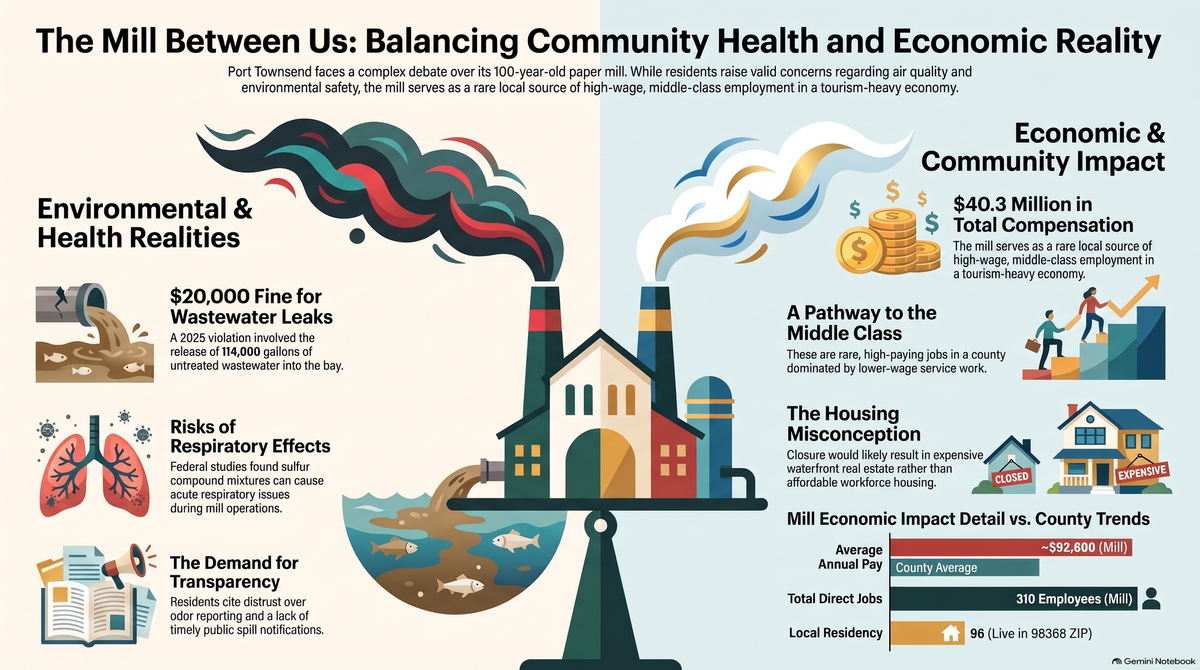
In 2025, the Washington Department of Ecology fined the mill $20,000 after two pipe leaks released wastewater into Port Townsend Bay. One incident involved approximately 114,000 gallons of untreated process wastewater. That is not anti-mill rhetoric. It is part of the mill’s record, and it demands accountability.
Residents’ health complaints also deserve more than a dismissive joke about the “Port Townsend aroma.” A federal health consultation found that concentrations of several contaminants were higher while the mill was operating and that a mixture of sulfur compounds could occasionally cause acute respiratory effects.
The same study also found important limits to the risk. Nearly all measured sulfur-dioxide readings were rated “good,” chronic sulfur-dioxide exposure was not expected to harm people’s health, and local asthma hospitalization rates were not statistically different from county or state rates.
That is what honest evidence looks like: concerning in places, reassuring in others, and inconvenient to anyone shopping only for a sound bite.
But recognizing the mill’s problems is not the same as pretending its disappearance would be cost-free—or automatically beneficial.
The mill employs roughly 300 people. A 2025 economic-impact study commissioned by the company reported 310 employees, average annual pay of approximately $92,600, and $40.3 million in total employee compensation. It also estimated that the mill supports additional jobs and economic activity throughout Jefferson County.
Because the study was commissioned by the mill and relies partly on economic modeling, its broader multiplier claims should be treated as estimates, not unquestionable fact. The direct jobs, payroll, and purchases, however, are real.
These are unusually well-paying jobs in a county increasingly built around retirement income, tourism, healthcare, construction, and lower-wage service work. Losing them would not simply remove a smokestack from the view. It would remove paychecks, apprenticeships, purchasing power, and one of the few remaining pathways into a solid middle-class livelihood that does not require leaving the Olympic Peninsula.
There is a strain of local thinking—not shared by every retiree and certainly not every mill critic—that treats the mill as an unpleasant leftover from a less enlightened age. From the comfort of a purchased home, investment income, or a pension earned somewhere else, it can be easy to imagine that an industrial employer can simply be canceled and replaced by something cleaner, quieter, and more tasteful.
Perhaps waterfront housing. Perhaps cafés, walking paths, and attractive mixed-use buildings.
Almost certainly expensive ones.
Closing an operating mill does not magically produce affordable housing. Demolition, environmental investigation, cleanup, infrastructure, and redevelopment can consume years and enormous amounts of money. Even ordinary housing construction here struggles to reach working households without substantial public subsidy. Port Townsend’s own planning documents acknowledge severe housing-cost burdens and the need for both affordable rentals and workforce homeownership.
If we cannot consistently produce affordable housing on vacant or publicly owned land, we should be skeptical of the fantasy that a complicated former industrial site would naturally become a working-family neighborhood.
This brings us to one of the statistics frequently used against the mill: the claim that most of its workers live outside the county.
First, we should get the number right.
The mill’s economic study says 96 of its 310 employees lived in the 98368 ZIP code. It does not establish that everyone else lives outside Jefferson County. Port Hadlock, Chimacum, Quilcene, Brinnon, and other county communities are not in the Port Townsend ZIP code.
More importantly, even if a large share of employees does commute from outside the county, what does that prove?
Does it prove the jobs have no local value? Or does it demonstrate that the people who work here cannot find housing here?
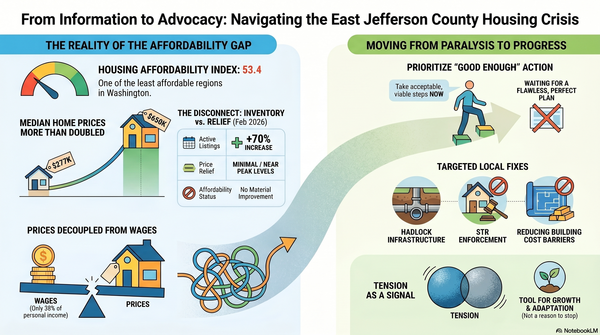
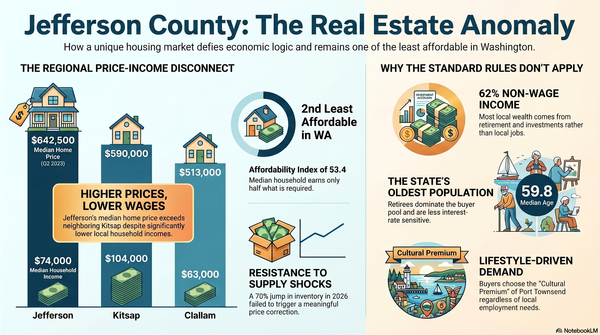
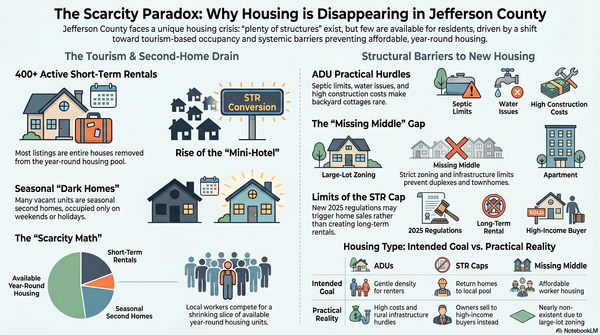
Port Townsend itself acknowledges that rapidly rising prices have driven out people who have long lived and worked in the community and that the lack of affordable housing harms local employers, schools, services, and families.
We cannot price workers out of the county and then cite their commuting distance as evidence that their jobs do not matter to us.
That is not economic analysis. It is circular reasoning.
The deeper problem is distrust.
Many residents believe the mill minimizes complaints, speaks publicly only when permits or public opinion require it, and reaches for an economic-impact report whenever environmental questions become uncomfortable.
Mill workers and supporters, in turn, hear every complaint as another step toward closure. They see people who arrived long after the mill was built demanding the elimination of jobs held by families who have been here for generations.
Both sides have evidence for their distrust. Both sides also use that distrust as permission not to listen.
Construction of the mill began in 1927, and production started in 1928. Nearly all of us arrived after that bargain had already been made. That history matters, but it does not give the mill permanent immunity from modern environmental and safety standards.
Likewise, moving near an existing industrial operation does not deprive residents of the right to clean water, accurate monitoring, meaningful enforcement, and a reasonable quality of life.
The mill has a right to operate within its permits. It does not have a right to violate them.
Residents have a right to demand health and environmental protection. They do not have an automatic right to erase a lawful employer because its presence conflicts with a preferred vision of Port Townsend.
Rights alone, however, will not repair the relationship.
That requires the mill to become radically more transparent: timely public reporting of spills and significant releases, understandable emissions data, independent safety and infrastructure reviews, published improvement schedules, and regular meetings where management answers unscripted questions.
It also requires mill opponents to say plainly what they are proposing. If the objective is closure, what replaces hundreds of family-supporting jobs? Who pays for cleanup? What happens to city utility finances, local suppliers, and displaced workers? What evidence shows that redevelopment would produce genuinely affordable housing instead of expensive waterfront real estate?
“Something better will come along” is not a transition plan.
The choice is not between accepting every mill impact and pretending the mill contributes nothing. The real choice is whether we can still conduct civic life without reducing one another to villains.
We should demand a cleaner, safer, and more accountable mill. We should also acknowledge that keeping working families, industrial skills, and year-round economic activity in Jefferson County has value.
Those ideas are not contradictory.
The mill and the community do not need to love one another. After nearly a century, that may be asking too much.
But they do need to speak honestly, measure the same facts, and recognize that neither side gets to cancel the other.
Sources
- Washington State Department of Ecology, “Port Townsend Paper Fined $20,000 for Water Quality Violations,” September 18, 2025:
Department of Ecology enforcement announcement - Agency for Toxic Substances and Disease Registry, “Port Townsend Paper Corporation Health Consultation”:
ATSDR health consultation - Econsult Solutions Inc., “An Economic Cornerstone: Quantifying Port Townsend Paper Company’s Impact on Regional Prosperity,” May 30, 2025. Commissioned by Port Townsend Paper Company:
PTPC economic-impact study - City of Port Townsend, “2025 Comprehensive Plan Update”:
Port Townsend Comprehensive Plan - City of Port Townsend, “Community Housing”:
Port Townsend community-housing overview - Port Townsend Paper Company, “History”:
Port Townsend Paper Company history - Washington State Department of Ecology, “Port Townsend Paper,” including facility, permit, regulatory, and odor-reporting information:
Department of Ecology facility page