Part 8 - Jefferson County: "Stuck by Design"

Part 8: Regional Context — How We Compare
East Jefferson County sits in a strange—and revealing—position within the Olympic Peninsula and Puget Sound region.
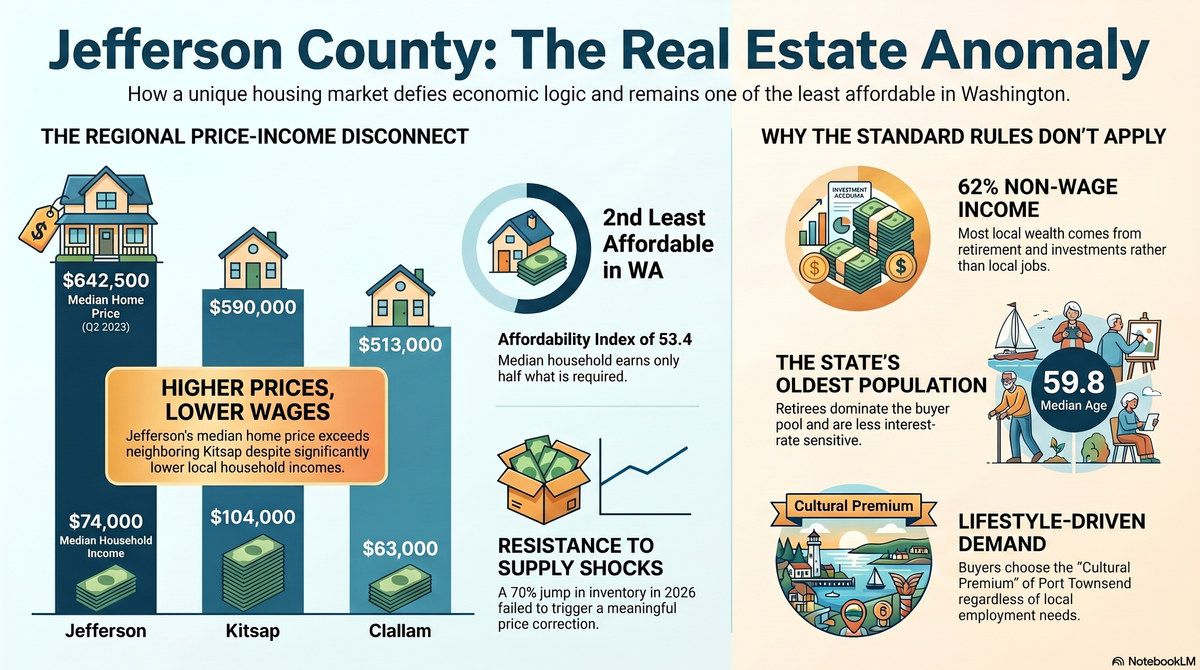
By the numbers, it’s one of the most expensive housing markets around. In Q2 2025, the median home price here reached $642,500. That’s higher than Clallam County ($513,000) and even Kitsap County ($590,000), trailing only San Juan County’s $1,020,000.
On its face, that doesn’t quite make sense.
Because typically, higher home prices follow stronger local economies—higher wages, more jobs, better access to employment centers. Jefferson County doesn’t follow that pattern.
And that’s where things start to get interesting.
The Price–Income Disconnect
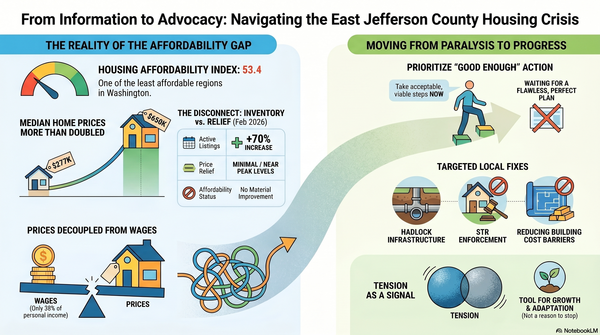
Jefferson County’s Housing Affordability Index sits at 53.4, making it the second least affordable county in Washington.
In plain terms: the median household earns just over half of what’s needed to afford the median home.
Now compare that to income.
The median household income here is around $74,000. That’s not dramatically different from Clallam County at about $63,000—and far below Kitsap County, where median income is closer to $104,000.
And yet…
Kitsap, with higher incomes and direct ferry access to Seattle employment, has lower median home prices than Jefferson.
Its affordability index reflects that. People who work there have a much better chance of being able to live there.
Jefferson flips that equation. Prices are high, but they’re not being supported by local wages.
What the Regional Market Is Doing (2026 Snapshot)
Across the region, the market is shifting—but not in the same way everywhere.
- Clallam County has moved toward balance, with prices roughly in the $400,000–$495,000 range and about three months of inventory.
- Kitsap County continues to show steady, moderate growth, with prices holding in the high-$500,000s.
- Island County has seen more volatility, with noticeable year-over-year price corrections.
- San Juan County remains its own category—high-priced, low-volume, and highly sensitive to wealth-driven demand.
Jefferson stands out again.
Inventory here jumped over 70% year-over-year in early 2026—the largest increase in the entire NWMLS region. But prices didn’t follow that increase downward in any meaningful way.
That’s not typical behavior.
In most markets, a surge in inventory creates downward pressure on prices. Here, it mostly created longer days on market and more negotiation—but not major price correction.
That tells us something important: this market doesn’t respond to supply changes the way a typical, wage-driven market does.
What Makes Jefferson Different
If you zoom out, the differences become clearer.
1. An Older Population
Jefferson County has the oldest median age in Washington—59.8 years.
Nearly 40% of residents are 65 or older. Only about 11.5% are under 18.
That’s not just a demographic detail. It shapes how housing is used, how often it turns over, and who is buying.
2. An Economy Not Driven by Local Wages
Only about 38% of personal income in Jefferson County comes from earned wages. The majority—about 62%—comes from retirement income, investments, and other non-wage sources.
That means a large share of housing here is being supported by wealth that was earned somewhere else.
It also means pricing isn’t anchored to local job markets in the same way it is in places like Kitsap.
3. A Different Kind of Buyer
When you look at who’s actually buying here, the dominant groups are retirees and lifestyle-driven buyers. The median buyer age is just over 61.
These buyers tend to be:
- Less sensitive to interest rates
- Less dependent on local employment
- More focused on lifestyle than affordability
That changes how demand behaves.
In commuter-driven markets, rising rates or falling affordability can slow demand quickly. In Jefferson, those pressures are muted.
4. Limited Connection to Employment Centers
Unlike Kitsap County, which has direct ferry access to Seattle, Jefferson doesn’t function as a commuter market.
People aren’t moving here because it’s the next affordable option.
They’re choosing it.
That distinction matters. It means demand is less about necessity and more about preference.
5. A Built-In “Cultural Premium”
Port Townsend’s historic character, arts community, and waterfront setting create something harder to measure—but very real.
People aren’t just buying a home here. They’re buying into a place with a strong identity.
That premium shows up in pricing, and there isn’t really a direct equivalent in neighboring counties.
The Bigger Picture
Jefferson County does follow some of the same broader trends as the rest of the state:
- Inventory is rising
- Prices are flattening
- Construction remains limited
But the way those trends play out here is different.
More extreme. Less predictable. And more resistant to correction.
Because the underlying drivers are different.
- The oldest population in the state
- A heavy reliance on non-wage income
- Limited ties to major job centers
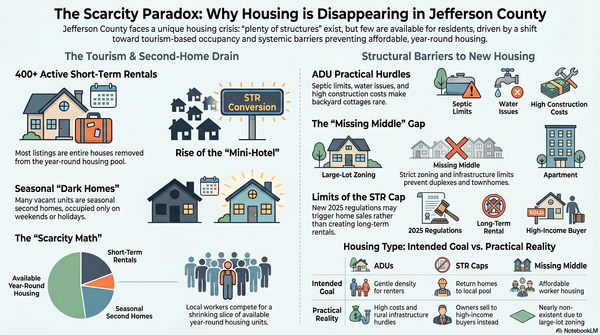
- A higher share of second homes and seasonal use
- And long-standing constraints on new housing supply
Put those together, and you get a market that doesn’t behave like its neighbors.
Not because something is broken.
But because it’s built on a completely different set of forces.
Why This Matters
This is where the idea of “Stuck by Design” becomes clearer.
In a typical market, high prices eventually trigger a response:
- More construction
- People priced out moving elsewhere
- Or demand cooling off
Here, those release valves don’t work the same way.
Demand isn’t tied to local wages.
Supply can’t expand easily.
And the people setting prices often aren’t affected by local economic limits.
So the system doesn’t correct itself.
It holds.
Where This Leads
If Jefferson County is operating under a different set of rules, then the real question becomes:
What actually changes it?
Because understanding how we compare is one thing.
Understanding what moves the needle… is something else entirely.