Part 6 - Jefferson County: "Stuck by Design"

Part 6 – The Economics of Building Here
If you stand in front of the “For Sale” board, or scroll the listings, and wonder, “Why don’t we just build more normal houses that regular people can afford?”, the honest answer is hard to hear:
At today’s costs, and under today’s rules, building in eastern Jefferson County – including Port Townsend, Hadlock/Irondale, Chimacum, Quilcene, and Brinnon – almost never pencils out at prices local workers can actually pay.
That didn’t happen overnight. It’s the result of decades of decisions and non‑decisions made while many of today’s renters and young families were still in school.
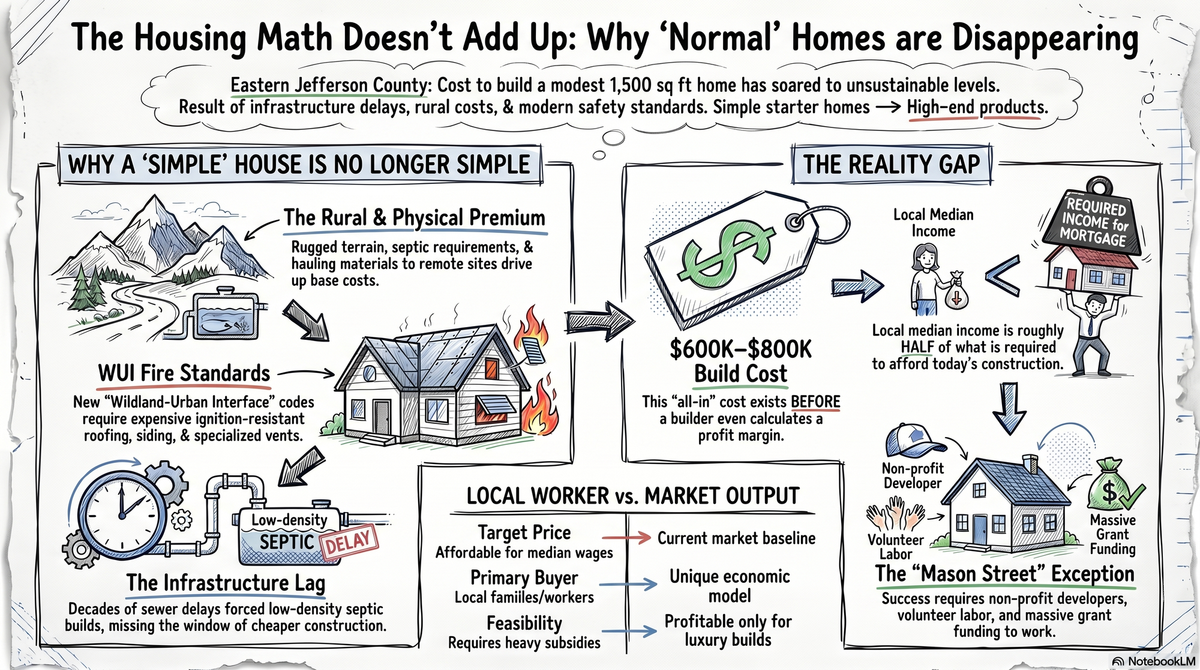
Why it’s so expensive to build a “simple” house
On paper, you can look up a statewide average construction cost and see a number that doesn’t sound too crazy. On the ground here, that number explodes.
To get from raw land to a finished, code‑compliant home, you are paying for:
- Site work: clearing, grading, retaining walls, drainage, and foundations that can handle wet, sloped, or unstable ground.
- Water and waste: wells or water connections, septic systems or sewer hookups, each with their own design, permits, and fees.
- Rural premiums: longer drives for crews, fewer contractors to bid jobs, and higher prices for materials that have to be hauled out here.
Layer on top the last ten years of rising material prices and labor costs. Lumber, concrete, roofing, windows, siding, and skilled trades have all gone up faster than local wages. Add updated energy codes, better insulation, tighter envelopes, and other “eco” requirements that are good policy but not cost‑free.
Now add a newer layer most people don’t see: wildland–urban interface (WUI) fire standards. In much of eastern Jefferson County, especially around Quilcene, Brinnon, and the wooded outskirts, you are effectively building in a fire‑prone landscape. That can mean:
- Ignition‑resistant roofing and siding
- Ember‑resistant vents and construction details
- Required defensible space and vegetation management around structures
Each of those lines shows up in a contractor’s estimate. None of them were as strict, or sometimes even present, when today’s codes were originally set and when many of the current homeowners bought in.
By the time you add everything up, a modest 1,500‑square‑foot home in this part of the county can easily land in the six‑hundred‑to‑eight‑hundred‑thousand‑dollar all‑in cost range, before the builder earns a profit. The “simple starter home” that existed in your parents’ era is now, by default, a high‑end product in terms of what it costs to produce.
Sewer: finally here, but only in some places
Infrastructure is the second big piece of the puzzle.
For twenty years, the Irondale–Port Hadlock Urban Growth Area was drawn on maps as the place where “real” housing capacity would go. On paper, it was zoned for townhomes, small apartments, and smaller lots. In reality, it stayed frozen at rural densities because the sewer system that made those plans possible was never actually built.
That delay matters. While prices were doubling and locals were getting priced out, the one place that could have absorbed hundreds of more attainable homes was stuck on septic. The window when land was cheaper, materials were cheaper, and borrowing was cheaper came and went while the pipes were still lines on a capital projects spreadsheet.
Phase I of the Hadlock sewer is finally done and operating. That’s a big deal. It means, for the first time, there are sites in Hadlock where the zoning, the maps, and the pipes all line up. You can actually imagine clusters of duplexes, triplexes, and small multifamily buildings serving everyday workers.
But Phase I is mostly commercial and immediate surroundings. The majority of the surrounding residential area still isn’t served, and Phase II doesn’t have money attached to it yet. So the one place designed to take real housing capacity is still only partially usable.
Every year of delay was a year when we could have been building more compact, sewer‑served, relatively efficient homes. Those years are gone.
Brinnon and Quilcene: cheaper on paper, expensive in reality
Brinnon and Quilcene tell a slightly different version of the same story.
On a real estate website, they often look “cheaper” than Port Townsend. You’ll see non‑waterfront homes with asking prices that, at a glance, feel more reasonable. But that headline price hides the economics of actually building there.
In these communities:
- Lots are often steep, wooded, and close to critical areas like streams and wetlands.
- There is no sewer system; every home is its own infrastructure project.
- WUI fire standards are front and center, because you are literally surrounded by forest.
By the time you clear trees, engineer driveways and foundations, put in a well and septic, meet fire requirements, and build the house itself, the per‑unit cost can be even higher than in town. And because the market is thin – only a handful of sales in some months – a builder cannot count on volume to spread those fixed costs.
So Brinnon and Quilcene end up in a strange position: they look like “the affordable option” on a map, but for new construction they’re often among the most expensive places to build a normal, legal house.
Mason Street: what it takes to build for local workers
Against that backdrop, the Mason Street Neighborhood in Hadlock stands out.
This is a large Habitat for Humanity project: a 100‑plus‑unit neighborhood on roughly 17 acres, made up of duplexes, triplexes, and small multifamily buildings. It is designed from scratch to serve local workers and families, with permanently affordable homes rather than market‑rate units that can flip into vacation rentals or second homes.
Mason Street is what success looks like under our current rules:
- It’s in the Hadlock UGA, on the new sewer line.
- It uses the allowed density instead of scattering homes on big rural lots.
- It’s designed as a walkable neighborhood with shared spaces and efficient buildings.
It is also a reality check on what it takes to pull something like this off:
- The developer is a nonprofit whose mission is affordability, not maximizing profit.
- The project depends on a stack of grants and public funding, including major infrastructure support that lowers the cost of serving the site.
- Habitat brings volunteer labor, donated or discounted materials, and a homeownership model that asks buyers to bring sweat equity as well as a mortgage.
Even with all of that – sewer, density, grants, volunteers – the homes are not “cheap” to build. They are only affordable to local households because almost every ingredient is arranged to push costs down and support up.
Mason Street proves two things at once:
- With enough intention, we can build a large neighborhood for local workers here.
- Under current economics, that kind of project does not happen by accident. It is the exception, not the norm.
Why the private market doesn’t fill the gap
Now put incomes into the picture.
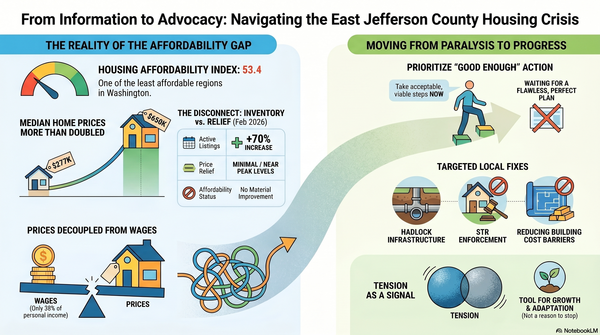
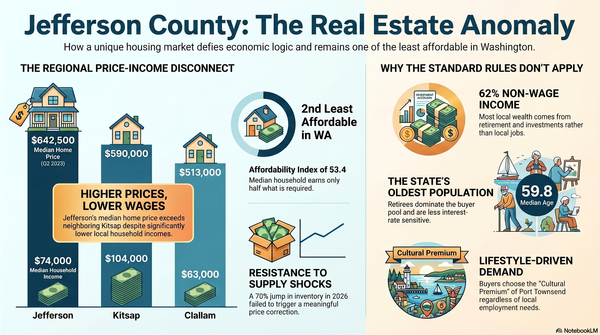
Local median household income sits far below what it takes to comfortably carry the kind of mortgage implied by a 600–800 thousand dollar build cost. The income needed to buy the median home is about double what the median household actually earns.
So a for‑profit builder in eastern Jefferson County is looking at something like this:
- High, baked‑in costs for land, infrastructure, materials, labor, and compliance.
- A thin pool of local buyers who can actually qualify for those prices.
- A much larger pool of equity‑rich retirees, remote workers, and second‑home buyers who can pay cash or make large down payments.
Given that setup, the market behaves exactly as you’d expect: it produces housing for the people with the most money, not the people with the deepest roots. Not because individual builders are villains, but because the math leaves them very little choice.
That is what “stuck” looks like in practice. Under the rules and cost structure we’ve built over the last 20–30 years, the system is calibrated to serve older, richer, often in‑migrating households, and to do very little for younger locals and working families.
How we got here – and why younger people feel boxed out
Most of the frameworks shaping today’s housing landscape were set when many of today’s renters and first‑time buyers were kids:
- Low‑density rural zoning that made scattered, infrastructure‑heavy housing the default outside small urban areas.
- Decades of delay on core infrastructure like the Hadlock sewer, even as demand and prices ramped up.
- Policy processes where retirees and established homeowners consistently showed up, while younger workers and renters struggled to be in the room.
- A gradual layering of energy, environmental, and fire‑safety standards that made each new home safer and more efficient, but also more expensive, with no parallel investment in making those homes financially reachable.
None of those decisions, by themselves, felt like they were “locking out” the next generation. Together, they add up to a reality where:
- The cost to build a modest home is beyond the reach of a typical local wage.
- The private market naturally serves the highest‑paying buyers.
- Mission‑driven projects like Mason Street are celebrated precisely because they are rare.
That is the reality this series is trying to lay bare: we are not stuck because of one bad actor or one bad year. We are stuck because, over decades, we built a system that works very well for some people and barely at all for others – especially the people who grew up here and are now trying to make a life in the place they call home.