Part 5 - Jefferson County: "Stuck by Design"

Part 5: Policy, Planning, Non‑Decisions – and Now, Opportunity Zones
If you zoom out, western Jefferson County’s housing crunch is not mainly about fickle buyers or mortgage rates; it is about a long series of policy choices and, more often, policy non‑decisions that boxed the market into a corner. Washington’s Growth Management Act locked almost all rural land into 1‑per‑5, 10, or 20‑acre zoning, while urban‑level density was confined to just two urban growth areas: the City of Port Townsend and the Irondale–Port Hadlock UGA. For thirty years, Port Townsend’s UGA line barely moved, and the one place where the county actually allowed urban zoning on paper—Port Hadlock—never got the sewer it needed to make that zoning real.
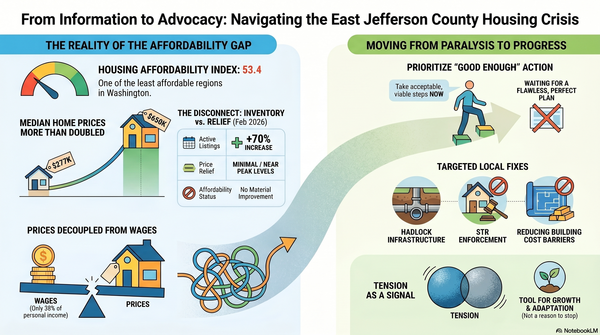
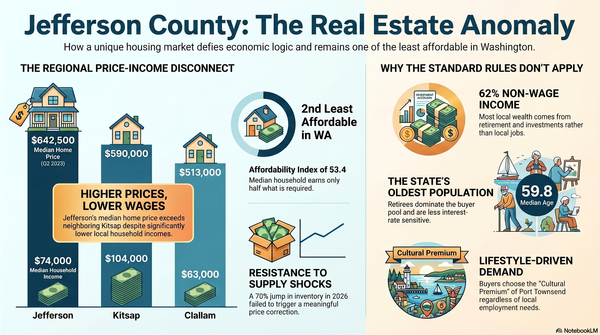
The result is a textbook case of how well‑intentioned rules can leave a place with sky‑high prices and nowhere for the workforce to go. The county’s own planning documents acknowledge that GMA‑style rural density limits simply do not mesh with the housing needs of a small, aging, amenity‑driven region where a large share of personal income comes from retirement, investment, and transfer payments instead of wages. When you combine that structure with decades of delay on Port Hadlock sewer, you get exactly what Jefferson County has today: a market priced by outside capital and retirees, not by local paychecks, and a severe mismatch between where people work and where they can afford to live.
The Port Hadlock Sewer: A 20‑Year Non‑Decision
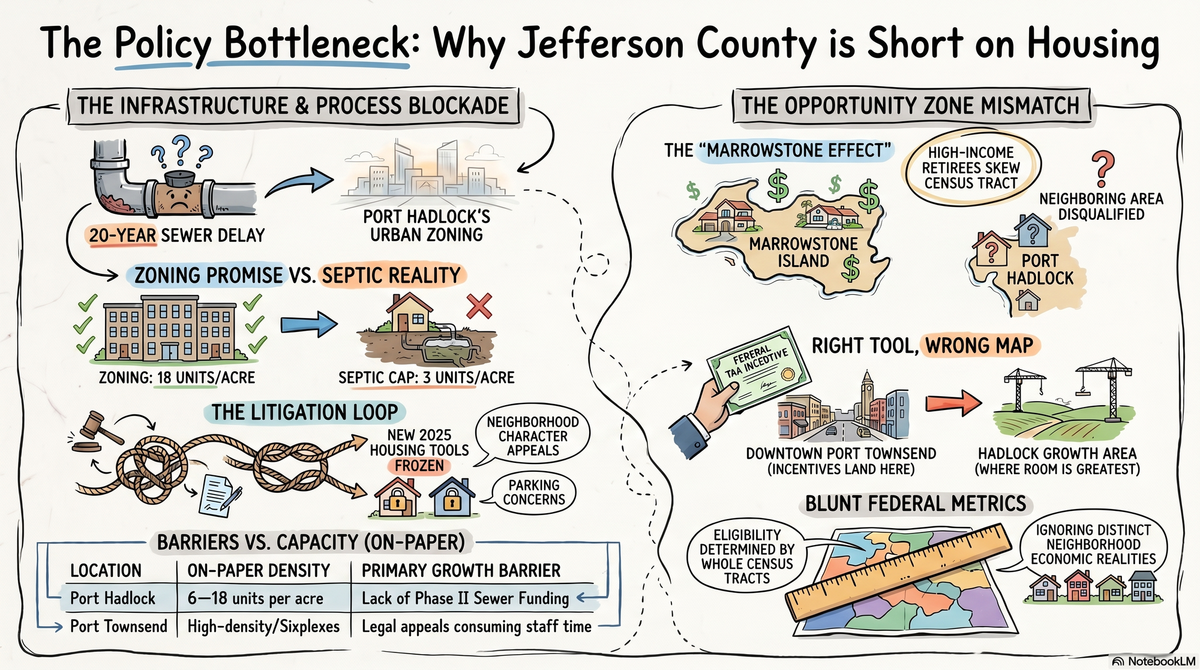
On paper, Port Hadlock and Irondale were supposed to be the relief valve. The county designated the area as an urban growth area in the early 2000s, zoned it for 6–18 units per acre, and talked about a “walkable town center” that could take pressure off Port Townsend. In practice, the sewer never arrived. Septic rules capped lots at about 12,500 square feet—roughly three units per acre—turning “urban” zoning into a mirage for two decades.
Phase I of the Hadlock sewer is finally built and serving the core commercial properties, which is a genuine breakthrough, but it also underlines how much time was lost. Had the community made this investment when the UGA was drawn, hundreds of units could have come online during the run‑up years when inventory collapsed and prices doubled. Instead, those years were spent talking about sewer, applying for grants, and watching housing costs run away from local incomes. Phase II—which would actually serve most of the residential areas—still has no funding, which means the gap between what the zoning promises and what the infrastructure allows remains only partly closed.
NIMBY Appeals and Frozen Bandwidth
Inside Port Townsend, the story is different but rhymes. After years of acknowledging a housing emergency, the city finally adopted a comprehensive plan in December 2025 that allowed more height, sixplexes in more neighborhoods, and a set of tools like multi‑family tax exemptions that are standard in other Washington cities. The council passed it—but the ink was barely dry before a group of mostly long‑time homeowners, Affordable Hometown Port Townsend, filed an appeal with the Growth Management Hearings Board.
The appeal is framed around affordability, but the group’s public comments centered on solar access for gardens, neighborhood “character,” and parking, not rents or wages. While the appeal plays out, city staff time that was supposed to go toward implementing affordability tools and zoning updates is instead being spent on litigation prep and procedural defensiveness. In other words, even when the community finally acts, the machinery of process and opposition slows the follow‑through.
Enter Opportunity Zones 2.0
Layered on top of all this, Jefferson County now finds itself in the middle of a new Opportunity Zones 2.0 designation cycle. Opportunity Zones are federally designated census tracts where investors get capital‑gains tax breaks if they roll profits into long‑term projects in those areas; the idea is to steer patient equity into communities that have been overlooked by traditional capital. States nominate tracts using federal low‑income criteria—mainly poverty rates and median family income—and Washington is now updating its map with new data.
From a local standpoint, this looks like a chance to finally align federal tax incentives with places that desperately need housing and mixed‑use investment. But the rules are blunt. Eligibility is determined at the census‑tract level, using median income for the whole tract, even when that tract stitches together very different neighborhoods. That is where Port Hadlock’s story takes a frustrating turn.
How Marrowstone’s Retirees Knock Out Hadlock
In the OZ 2.0 process, county staff flagged a problem: Port Hadlock’s census tract is bundled with Marrowstone Island, a retirement‑heavy, higher‑income area where many residents live on investment and pension income rather than wages. Those retirees are not necessarily high‑wage workers, but their resources are large enough to push the tract’s median family income over the federal cutoff for “low‑income.”
Because Opportunity Zone eligibility is tied to that blended median, the tract that contains Port Hadlock—and the one part of the county where urban‑level sewer and zoning are just now coming online—is disqualified from OZ 2.0. The area that arguably offers the greatest long‑term return on workforce housing and mixed‑use investment is excluded, not because the Hadlock core is affluent, but because of a pocket of relatively well‑off retirees living miles away on Marrowstone.
This does not make Port Townsend’s or any other local Opportunity Zone a “bad” choice; it just shows how a one‑size‑fits‑all federal metric can miss local reality. In Jefferson County’s case, the math is being set not by teachers, hospital staff, and service workers in Hadlock, but by older households whose retirement income tilts the averages.
Downtown Port Townsend as the Third Zone
Against that backdrop, the new map points toward a third Opportunity Zone centered on Port Townsend’s downtown corridor. The city already participates in OZ initiatives through the Emerald Coast partnership, which has highlighted the waterfront and adjacent blocks as prime candidates for reinvestment—think upper‑floor apartments, small‑scale infill, and rehab of under‑used commercial buildings.
Designating the downtown corridor as an OZ makes sense on its own terms. It is the county’s main jobs center, has a mix of older buildings and modest resident incomes, and offers a walkable environment where more housing could directly reduce commute burdens and vehicle miles traveled. The problem is not that downtown PT is getting attention; the problem is that the mechanics of federal eligibility mean Hadlock—the place with new sewer, “on‑paper” density, and the most room to grow—is not even in the conversation.
The Pattern: Incentives That Arrive Just Off Target
When you look across these decisions, a pattern emerges.
- The GMA set up a framework that protects rural character but left almost no flexible land for new housing.
- The Port Hadlock UGA was created but went decades without sewer, so its zoning could not be used.
- Port Townsend finally adopted more ambitious housing policies, only to see them tied up in an appeal that consumes the very staff time needed to implement them.
- Now, the one big federal incentive that could help scale up mixed‑income projects—Opportunity Zones 2.0—lands on Port Townsend’s downtown corridor and skips right over Hadlock because of a statistical income bump from Marrowstone’s retirees.
None of these moves were designed to keep nurses, teachers, and service workers priced out, but together they do exactly that. The investors who show up with OZ capital will not be villains; they will be responding rationally to a map drawn with blunt instruments. The question for Jefferson County is whether it can now use the tools it does control—sewer Phase II funding, local incentives, enforcement of short‑term rental caps, and state‑level advocacy—to redirect some of that energy back into the places where it will matter most for the people who keep the local economy running.