Part 1 - Jefferson County: "Stuck by Design"
Part 1 - Where We Are Now: High, Slow, and Stuck Right now, East Jefferson County’s housing market lives in a strange in‑between zone.

Part 1: Where We Are Now: High, Slow, and Stuck (and much longer than I intended)
Right now, East Jefferson County’s housing market lives in a strange in‑between zone. Prices are still high, there are finally more homes for sale, everything is taking longer to move, and yet the real relief buyers and renters were hoping for hasn’t arrived.
Prices: Near the Top, Not Really Coming Down
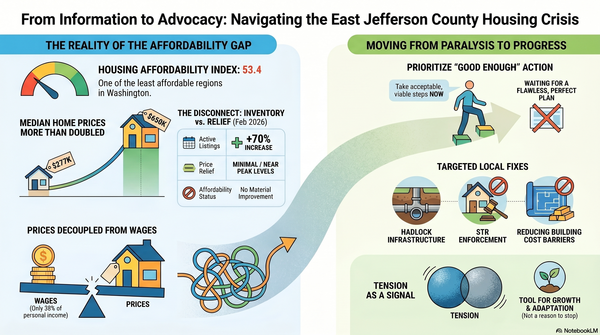
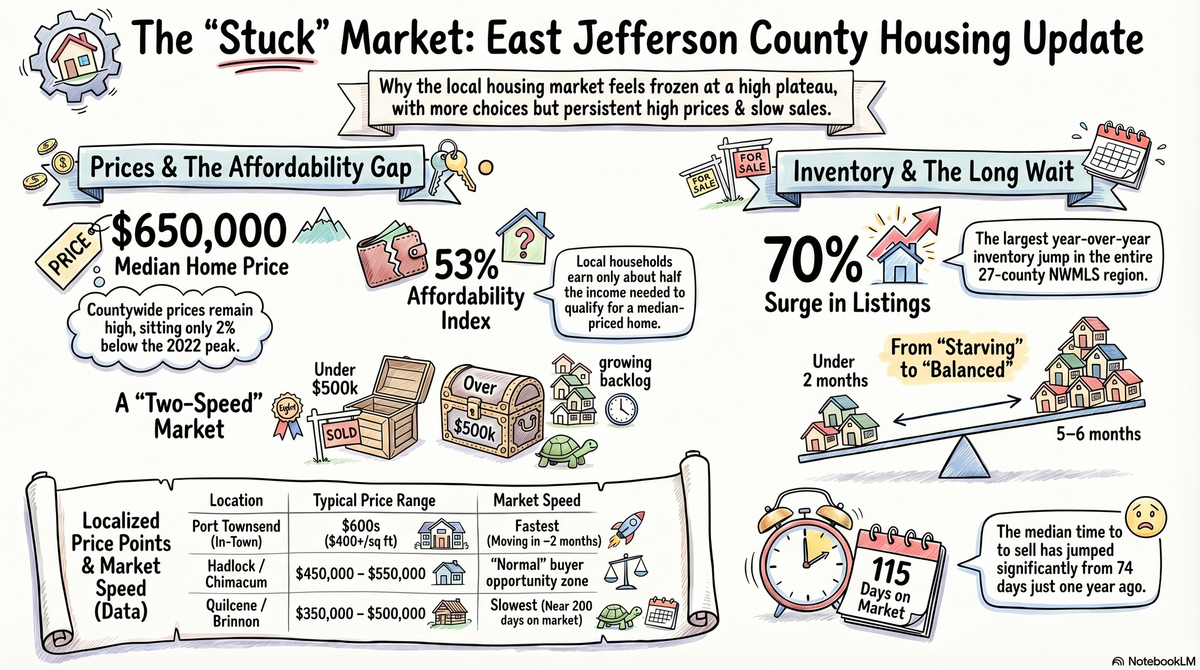
Countywide, the median home price is around $650,000—roughly 2% below the 2022 peak. Residential-only sales run a bit higher, in the mid‑$600s. The big run‑up is over, but we haven’t seen a serious price rollback.
On the ground that looks like:
- In‑town Port Townsend: Typical values in the low‑ to mid‑$600s, often $400–$415 per square foot for a well‑located, move‑in‑ready home
- Port Hadlock / Irondale / Chimacum: Generally $100,000–$150,000 below Port Townsend, with many sales in the mid‑$400s to mid‑$500s.
- Quilcene / Brinnon (Highway 101 corridor): Many non‑waterfront homes in the $350,000–$500,000 range, with waterfront easily two to three times that.
For buyers, it feels like the music stopped, but the ticket prices didn’t change. For existing owners, it feels like they’re still sitting on 2022 values—but it’s harder to turn that equity into an actual sale.
Inventory: From “Nothing to Buy” to “Plenty to Look At”
The biggest shift in the last year is inventory. By early 2026, Jefferson County’s active listings were up about 70% year‑over‑year—the largest jump in the entire 27‑county NWMLS region. Months of supply, which had sat under 2 months during the pandemic frenzy, pushed into the 5–6-month range in parts of 2025.
That’s classic “balanced market” territory on paper. But context matters. Even after the surge, Q2 2025 inventory—about 157 active listings—was still below pre‑COVID levels, around 189. We’re not flooded; we’re just no longer starving.
If you tried to buy a house here in 2021 and saw three listings total in your price range, today’s market feels like a relief: more choices, more time, more room to negotiate. If you’re selling, it feels like suddenly you have real competition.
Days on Market: The Long Wait
The clearest day‑to‑day change is the length of time homes sit. County‑wide median days on market hit about 115 days in February 2026, up from roughly 74 days a year earlier. That’s nearly four months for the median sale.
It doesn’t look the same everywhere:
- In‑town Port Townsend remains the fastest segment, with many well‑priced homes still moving in roughly two months, sometimes a bit more.
- Outskirts around PT—acreage and view properties—often list $100,000–$300,000 above in‑town prices and take significantly longer, as the buyer pool shrinks with each price jump.
- Quilcene and Brinnon are at the other extreme, with median days on market near 200 days and some months logging only a handful of sales.
If you’re a seller, this is where the “stuck” feeling really sets in. You’ve listed, you’ve tidied the house, you’ve had a few showings—and then…nothing, for weeks at a time.
What “Stuck” Actually Means Here
When I describe this as a stuck market, I don’t mean a crash. I mean a market where the pieces don’t quite fit together.
Here’s what that looks like in everyday terms:
- Sellers still price like it’s 2022. Most new listings come close to peak values. On average, sellers are giving up only about 2.5–3% off list price—sale‑to‑list ratios around 96–97.5%—so big “fire sale” discounts are rare.
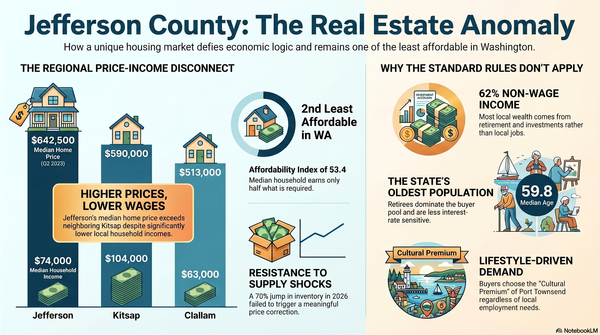
- Local buyers can’t pencil it out. The Housing Affordability Index for Jefferson County is around 53, meaning the median household earns only about 53% of what it takes to qualify for the median‑priced home at current rates. For first‑time buyers, the index is even worse.
- A two‑speed market by price. Below about $500,000, inventory runs close to 3.3 months—still modestly seller‑leaning. Above $500,000, months of supply rise to 4.5 and beyond, and homes take longer to absorb. In plain language: the “affordable” end is still tight; the upper half has a noticeable backlog.
- Huge differences by location. In‑town Port Townsend still feels somewhat competitive. Hadlock/Chimacum is where “normal people” have the best chance of owning. The 101 corridor is thin and slow—especially off‑water—with ultra‑premium pricing on waterfront.
Put together, you get a plateau: more signs in the yards, longer waits for offers, but no real break in prices. Buyers feel like the market is too expensive. Sellers feel like the market is too quiet. Both are right.
How Jefferson Compares to the Peninsula, Washington, and the U.S.
All of this is happening inside a much bigger story: the Pacific Northwest, Washington State, and even the country as a whole have been under‑building housing for years. Our local “inventory surge” is real, but it’s happening on top of a deep, long‑term shortage.
Jefferson vs. the Olympic Peninsula
Even among its closest neighbors, Jefferson is the outlier.
- Q2 2025 median sale price in Jefferson sits around $642,500, versus about $513,000 in Clallam.
- Jefferson’s Housing Affordability Index is about 53, compared to roughly 55 in Clallam. Both are bad, but Jefferson is worse.
- Both counties have seen inventory climb into early 2026, but Jefferson’s increase—around 70% year‑over‑year—is the most dramatic.
So even on the Olympic Peninsula, Jefferson is the older, pricier, less affordable cousin.
Jefferson vs. Washington State
Washington as a whole is one of the most housing‑starved states in the country.
- Statewide, median home prices run in the mid‑$500Ks to just under $600K, and only about one in four Washington households can afford the median‑priced home.
- Multiple statewide analyses estimate a six‑figure housing unit deficit going into the 2020s—roughly 225,000 “missing” homes from earlier underbuilding, plus ongoing shortfalls.
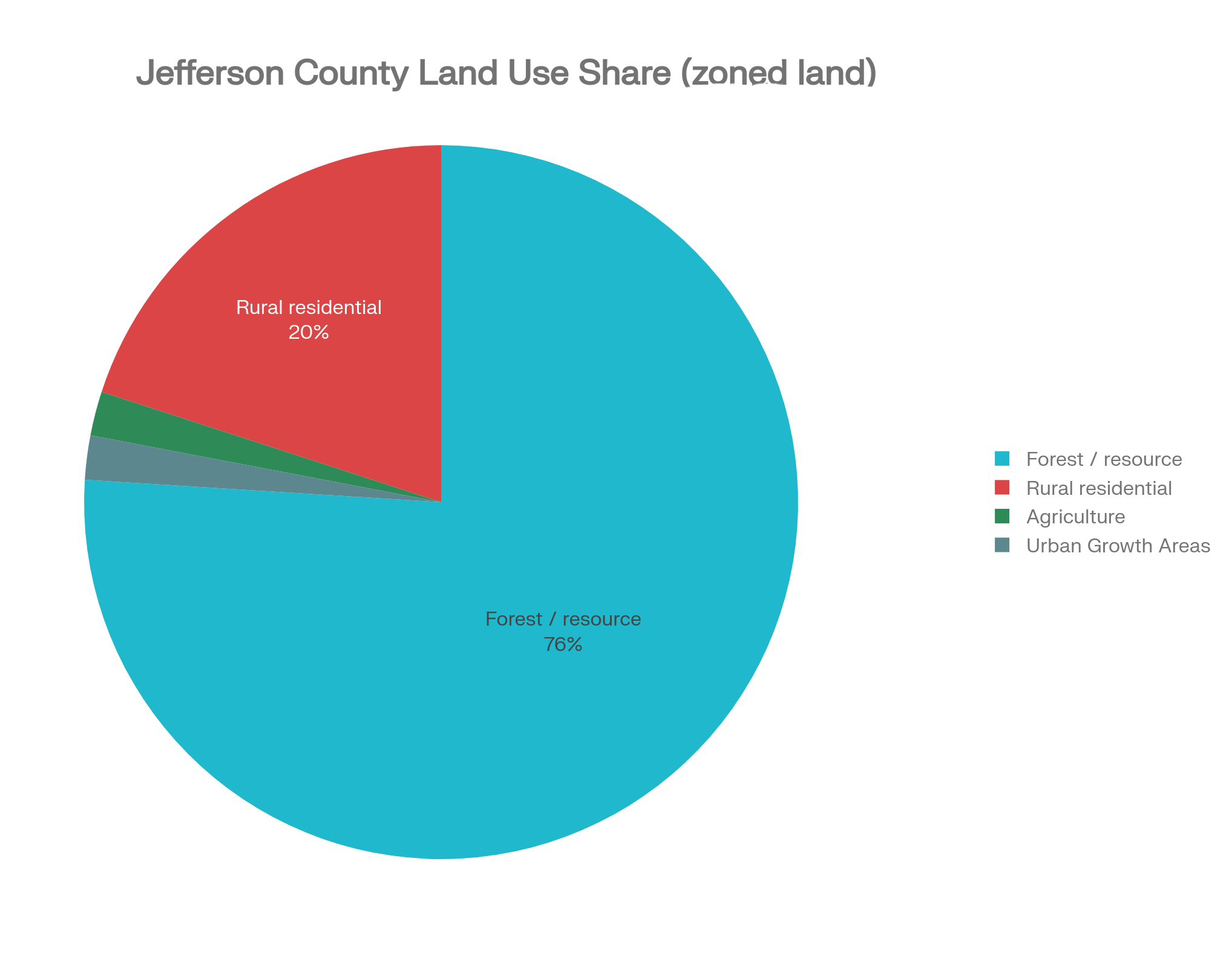
- Listings have increased sharply since 2023, but from an extremely low base, and almost all of the state’s growth capacity is squeezed into Urban Growth Areas that cover less than 4% of the land. This is IMPORTANT. Roughly three‑quarters of Jefferson County’s zoned land is locked up in commercial forest and other resource designations, only a small single‑digit percent sits inside Urban Growth Areas like Port Townsend and Port Hadlock, and most of the remaining land is rural residential at 5‑, 10‑, or 20‑acre minimums. On top of that, a majority of our forest land is publicly owned, which means only a thin slice of the county is even on the table for future housing.
Jefferson’s 70% surge sits within that context. It changes how our local market feels, but it doesn’t suddenly make us “well‑supplied” in a state that still hasn’t built enough housing.
Jefferson vs. the National Market
National headlines about “falling home prices” are technically true in a few places, but the bigger story is flattening, not crashing.
- Across the country, home values grew only about 1.3% in 2025—the weakest gain in 14 years—but they still grew.
- The major national home price indices are hovering just below all‑time highs, not 20% off the peak.
Jefferson fits the pattern of “plateau at a high level”—but with two important twists:
- Our prices never really dipped. County medians from 2022 to 2025 have been essentially flat to slightly up, despite higher mortgage rates and a big drop in sales volume.
- Our prices are being set by equity‑rich retirees and remote workers more than by local wage earners. That makes demand less sensitive to interest rates than in a typical job‑center metro, and helps explain why national “cooling” hasn’t shown up here as real price relief.
The Big Picture in One Paragraph
At the national level, prices have mostly stopped climbing and are drifting sideways. At the state level, Washington is still tens of thousands of homes short of what we need, even after a bump in listings. On the Olympic Peninsula, Jefferson County is the most expensive and least affordable of the bunch. And here at home, we’ve moved from “nothing to buy” to “plenty to look at,” but we’re still living with 2022‑style prices on 2026 incomes.
That’s what “stuck” really means in East Jefferson County: we’re no longer in a frenzy, but we’re also nowhere near affordable.